
This document introduces the features and characteristics of the MtronPTI M3H & MH Series 8 pin DIP, 3.3 or 5.0 Volt, HCMOS/TTL Clock Oscillator Pin Connections product.
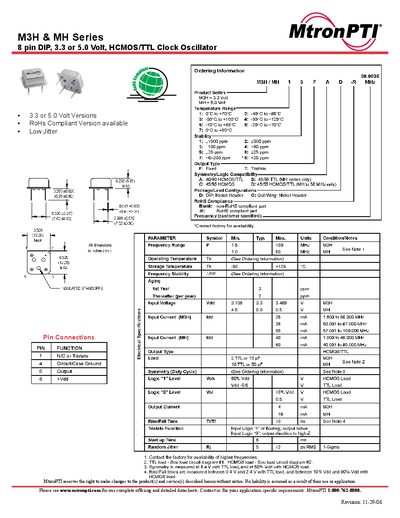
The M3H and MH series are 8‑pin DIP clock oscillators available in 3.3 V (M3H) or 5.0 V (MH) versions. They offer low jitter and a range of frequency options up to 100 MHz, suitable for HCMOS/TTL applications.
The sheet lists ordering options, temperature ranges, stability figures, output types, and RoHS compliance. Detailed electrical parameters such as supply voltage, output current, rise/fall times, and jitter are included, along with pin‑out diagrams and notes on load conditions.
| Frequency Range (M3H) | 15 – 100 MHz |
|---|---|
| Operating Temperature Range | -40 °C to +85 °C (typical) |
| Supply Voltage (M3H) | 3.135 – 3.465 V |
| Supply Voltage (MH) | 5.0 – 5.5 V |
| Output Current (M3H) | up to 4 mA |
| Rise/Fall Time | ≈10 ns |
| Random Jitter | 5 – 12 ps RMS |
| Frequency Stability | ±11000 ppm (typical) |
The M3H series covers frequencies from 15 MHz to 100 MHz.
The M3H oscillator operates from 3.135 V to 3.465 V.
The M3H can source up to 4 mA on its output.
Rise and fall times are about 10 ns.