
The document provides detailed information about the approximate dimensions, materials, and performance specifications of the triaxial accelerometer with model number 3053B2.
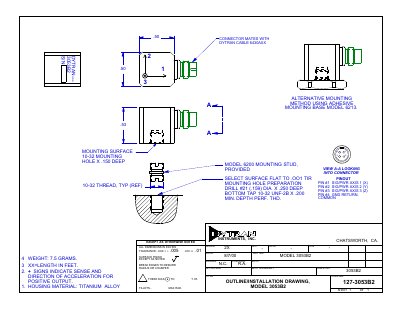
This document provides the full technical specifications for the Instrument Instruments 3053B2 triaxial accelerometer. It includes physical dimensions, weight, housing material, and mounting options, as well as performance parameters such as sensitivity, frequency response, and natural frequency.
Environmental limits, electrical characteristics, and connector pinout are also listed, giving engineers the data needed for integration, power supply design, and signal conditioning.
| Weight | 7.5 grams |
|---|---|
| Size (H × W × D) | 0.53 × 0.50 × 0.50 inches |
| Mounting | 10-32 tapped hole in base |
| Housing material | Titanium alloy |
| Sensitivity | -10 % to +15 % |
| Full‑scale range | ±500 g (10.0 mV/g) |
| Frequency response | 2 – 5000 Hz |
| Natural frequency | 30 kHz |
| Electrical noise | 0.007 g RMS |
| Linearity | 1 % of full scale |
| Transverse sensitivity (max) | 5 % |
| Temperature range | -60 °F to +250 °F |
| Maximum vibration | ±600 g |
| Maximum shock | 5000 g |
| Supply voltage range (each axis) | +18 V to +30 V DC |
| Output impedance (typ.) | 100 Ω |
| Output bias voltage (nom.) | +10 V DC |
| Discharge time constant (nom.) | 0.5 s |
| Ground isolation (min.) | 10 MΩ |
It mounts with a 10‑32 tapped hole in the base, and an adhesive mounting base is also offered as an alternative.
The device operates from –60 °F up to +250 °F.
Each axis requires a supply voltage between +18 V and +30 V DC.
The accelerometer can withstand shocks up to 5000 g.