
This document details the features and characteristics of the 3273A1, 3273A2, and 3273A4 accelerometers, including the acceleration range, resolution, operating temperature range, weight, connector type, material, isolation, sensing element material, working mode, sensitivity, frequency range, resonance frequency, linearity, phase response, transverse sensitivity, noise floor, and spectral noise.
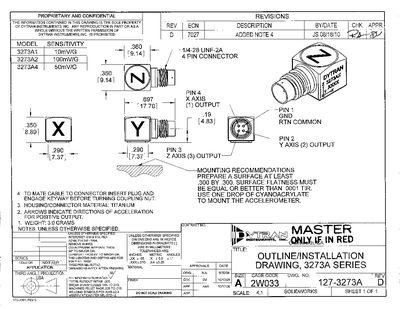
This document provides the outline and installation drawing for the Dytran 3273A series triaxial accelerometer, including mounting recommendations, connector details, and mechanical dimensions. It also lists the performance specifications such as sensitivity, frequency range, and environmental limits.
Key sections cover mounting instructions (surface size, flatness, adhesive use), electrical characteristics (supply current, bias voltage), and environmental tolerances (temperature range, vibration limits). The drawing uses both inch and metric units for clarity.
| Sensitivity (3273A2) | 100 mV/g |
|---|---|
| Sensitivity (3273A4) | 50 mV/g |
| Weight | 3.0 grams |
| Operating Temperature | -60 °F to +165 °F |
| Frequency Range (3273A2) | 7 – 3000 Hz |
| Noise Floor | 0.00095 g RMS |
Prepare a surface at least 0.300 × 0.300 inches with flatness equal to or better than 0.0001 in, and use one drop of cyanoacrylate to mount the accelerometer.
The accelerometer weighs 3.0 grams.
Model 3273A2 has a sensitivity of 100 mV per g.