
This document describes the features and characteristics of a typical connection half-bridge driver, including floating channel for bootstrap operation, operational up to +600V, tolerant to negative transient voltage, gate drive supply range from 10V to 20V, compatible with 3.3V, 5V, and 15V input logic, cross-conduction prevention logic, matched propagation delay for both channels, high side output in phase with IN input, logic and power ground +/- 5V offset, internal 540ns deadtime (programmable up to 5µs for IRS21094), lower di/dt gate driver for better noise immunity, and shutdown input that turns off both channels.
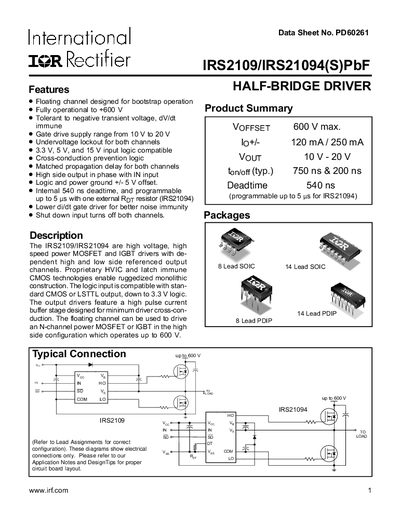
The IRS2109/IRS21094(S)PbF driver provides a floating high‑side channel for bootstrap operation and supports both MOSFET and IGBT loads up to 600 V. It offers a wide gate‑drive supply range (10‑20 V), undervoltage lockout, and cross‑conduction prevention logic, making it suitable for high‑speed switching applications.
The device is available in 8‑lead PDIP, 8‑lead SOIC, 14‑lead PDIP and 14‑lead SOIC packages, with options for tape‑and‑reel packaging. Detailed electrical characteristics, timing diagrams, and lead definitions are provided to aid PCB layout and system integration.
| Maximum high‑side floating voltage (VOFFSET) | 600 V |
|---|---|
| Gate‑drive supply range (VOUT) | 10 V‑20 V |
| Dead‑time (typical) | 540 ns |
| Floating channel operation | Designed for bootstrap operation |
| Undervoltage lockout | Enabled for both channels |
The driver can tolerate up to 600 V on the high‑side floating supply.
The driver has a fixed dead‑time of 540 ns, which can be programmed up to 5 µs on the IRS21094 version.
The driver operates with a gate‑drive supply between 10 V and 20 V.