
This document describes the BCV61 model NPN silicon double transistor, which can be used as a current mirror. It has good thermal coupling and VBE matching, high current gain, and low collector-emitter saturation voltage.
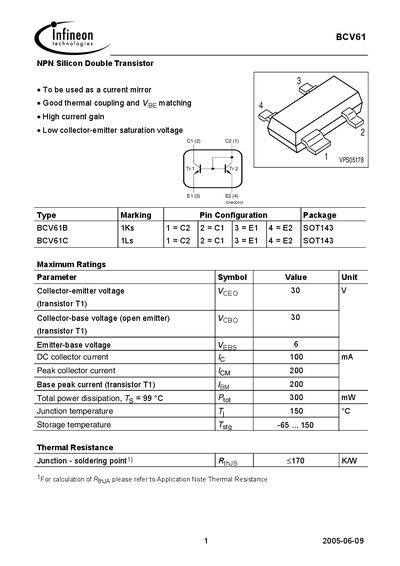
The BCV61 is an NPN silicon double transistor designed for current‑mirror applications, offering good thermal coupling, high current gain, and low collector‑emitter saturation voltage. The datasheet lists its maximum ratings, DC and AC electrical characteristics, and thermal specifications.
Key data include a collector‑emitter voltage of 30 V, collector‑base voltage of 30 V, emitter‑base voltage of 6 V, and a typical transition frequency of 250 MHz. The device is supplied in a SOT‑143 surface‑mount package with detailed footprint and marking information.
| Collector‑emitter voltage (VCEO) | 30 V |
|---|---|
| Collector‑base voltage (VCBO) | 30 V |
| Emitter‑base voltage (VEB) | 6 V |
| DC collector current (IC) | 100 mA |
| Peak collector current (IC peak) | 200 mA |
| Transition frequency (ft) | 250 MHz |
| Collector‑base capacitance (Ccb) | 0.95 pF |
| Package type | SOT‑143 |
The BCV61 can withstand up to 30 V between collector and emitter.
The device is supplied in a SOT‑143 surface‑mount package.
The typical transition frequency is 250 MHz.