
This document introduces the preliminary specification of TDA5255 E1 ASK/FSK 434MHz wireless transceiver
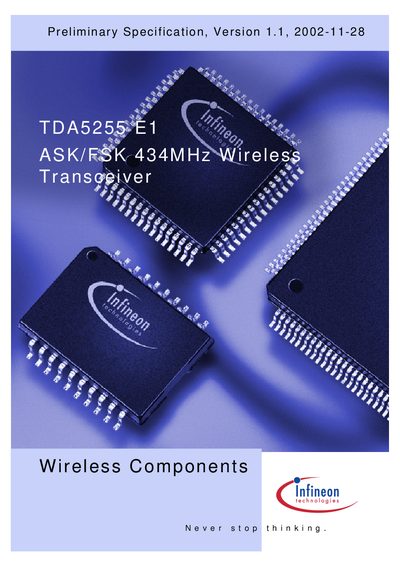
The TDA5255 E1 is a single‑chip FSK/ASK transceiver designed for low‑bit‑rate communication in the 433‑435 MHz band. It integrates a power amplifier, low‑noise amplifier with AGC, double‑balanced mixer, VCO, PLL synthesizer, crystal oscillator, data filter, slicer, peak detectors, and a 2/3‑wire bus interface, plus a power‑down mode for battery‑saving operation.
The device supports supply voltages from 2.1 V to 5.5 V, typical receive current of 9 mA and transmit current of 13 mA, transmit power up to +13 dBm, sensitivity better than –109 dBm, and data rates up to 100 kBaud Manchester‑encoded. It is offered in a P‑TSSOP‑38‑1 package and meets ETSI EN300 220 and CEPT ERC 7003 regulations.
| Supply voltage range | 2.1 V – 5.5 V |
|---|---|
| Typical receive current | 9 mA typ. |
| Typical transmit current | 13 mA typ. |
| Transmit power | +13 dBm |
| Sensitivity (ASK/FSK) | < -109 dBm |
| Maximum data rate | 100 kBaud (Manchester encoded) |
| Operating temperature range | -40 °C to +85 °C |
It operates from 2.1 V to 5.5 V.
The typical receive current is 9 mA.
It can transmit up to +13 dBm.
Both ASK and FSK sensitivities are better than –109 dBm.