
SPD08N50C3 is a new type of MOS power transistor launched by Infineon. It features extremely low RDS(on), extremely low gate charge, extreme dv/dt rating, extremely low effective capacitance and improved transconductance.
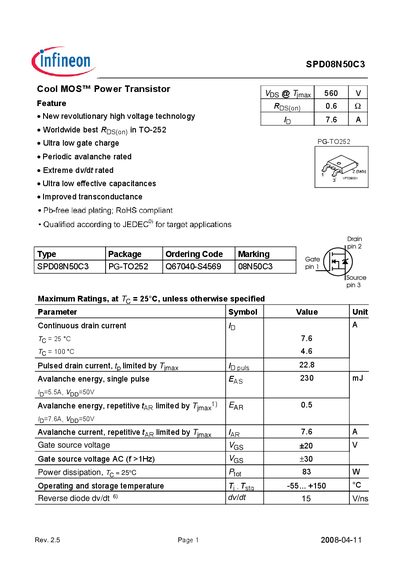
The SPD08N50C3 is a 560 V Cool MOS power transistor offered in a TO‑252 package. It features ultra‑low gate charge, low on‑resistance, and is RoHS compliant. The device is qualified for target applications according to JEDEC® standards.
The datasheet lists maximum ratings such as 560 V drain‑source voltage, 83 W power dissipation at 25 °C, and a pulsed drain current of 22.8 A. Detailed electrical characteristics include transconductance, capacitances, and gate‑charge curves, while thermal data provide junction‑to‑case and junction‑to‑ambient resistance values. Mechanical dimensions and package markings are also provided.
| Power Dissipation (25 °C) | 83 W |
|---|---|
| Pulsed Drain Current | 22.8 A |
| Avalanche Energy (single pulse) | 230 mJ |
| Operating Temperature Range | -55 °C to +150 °C |
It can dissipate up to 83 W when the case temperature is 25 °C.
The transistor can handle a pulsed drain current of 22.8 A.
The device operates from –55 °C up to +150 °C.