
This product is a dual 3:1 multiplexer with two digital inputs to control the analog signal path. Typical applications include switching a USB connector between USB and other operations such as serial communications, audio, and video.
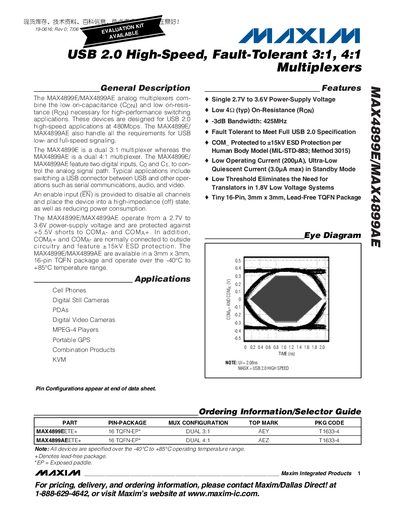
The MAX4899E (dual 3:1) and MAX4899AE (dual 4:1) analog multiplexers are designed for USB 2.0 high‑speed applications up to 480 Mbps. They feature low on‑capacitance, low on‑resistance, and built‑in fault‑tolerant circuitry that meets the full USB 2.0 specification, including +15 kV human‑body‑model ESD protection.
Typical applications include USB switching for cell phones, digital cameras, PDAs, GPS units and other portable devices. The devices operate from a 2.7 V to 3.6 V supply, are available in a 16‑pin 3 mm × 3 mm lead‑free TQFN package, and are rated for –40 °C to +85 °C operation.
| Supply Voltage Range | 2.7 V to 3.6 V |
|---|---|
| Typical On‑Resistance (Ron) | 4 Ω (typ) |
| Bandwidth (‑3 dB) | 425 MHz |
| ESD Protection (Human Body Model) | +15 kV |
| Package | 16‑pin 3 mm × 3 mm lead‑free TQFN |
| Operating Temperature Range | -40 °C to +85 °C |
The devices operate from a 2.7 V to 3.6 V power‑supply voltage.
Typical on‑resistance is about 4 Ω.
They are protected against up to +15 kV human‑body‑model ESD.