
TLP270D is an integrated design photocoupler suitable for DAA circuits in modems. It has multiple functions including photorelay, photocoupler, Darlington transistor, bridge rectifier, and Zener diode. The product is suitable for mobile devices, notebooks, personal digital assistants, multimedia TVs, and modems, etc.
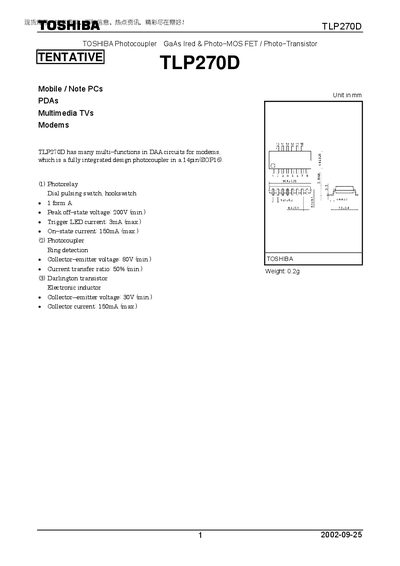
The TLP270D is a fully integrated GaAs photocoupler that combines a photorelay, photocoupler, Darlington transistor, bridge rectifier and Zener diode in a 14‑pin SOP package. It is intended for use in DAA circuits for modems, mobile devices, PCs and other general electronics applications.
The document lists the device's pinout, absolute maximum ratings, typical electrical parameters, switching characteristics and mechanical specifications such as package power dissipation and storage temperature range. It also includes safety and usage restrictions for designers.
| Isolation voltage | 1500 Vrms (min.) |
|---|---|
| Forward current IF | 50 mA |
| Collector‑emitter voltage VCEO | 80 V (min.) |
| Peak forward current | 1 A |
| Storage temperature range | -55 °C to 100 °C |
The isolation voltage is at least 1500 Vrms.
Maximum collector current is 150 mA.
The device can be stored from –55 °C to 100 °C.