
Atmel Flash memories are programmable erasable read-only memories implemented on an advanced sub-micron process using a highly efficient memory cell. They use Fowler-Nordheim tunneling for erasing and programming, requiring low programming current and supporting sector programming. Compared to first generation Flash memories, they offer a cleaner hardware implementation and more flexible and simple programming commands.
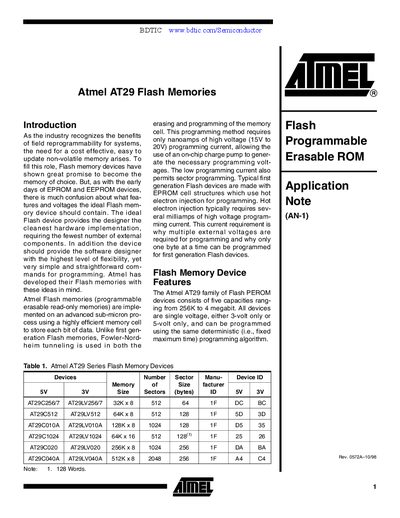
The Atmel AT29 Flash Memory Programming Manual describes the AT29 family of flash PEROM devices, their capacities, voltage options, and the deterministic programming algorithm used for all devices. It explains the small‑sector architecture that enables fast, independent sector updates without pre‑erase, and details the built‑in hardware and software protection features.
The document provides step‑by‑step programming procedures, timing diagrams, and troubleshooting tips such as data polling and toggle‑bit monitoring. It also includes specifications for programming voltage, current, and timing, helping designers integrate the AT29 devices into their systems efficiently.
| Capacities | 256K to 4 megabit |
|---|---|
| Operating Voltage | 3 V or 5 V single‑voltage devices |
| Programming Voltage Range | 15 V to 20 V |
| Sector Size | 128 bytes (1024 sectors for AT29C010A) |
| Noise Filter | Filters spikes < 15 ns |
The devices use a high‑voltage range of 15 V to 20 V for programming.