
This document is the AT49BV163D(T) product introduction manual, which introduces the features and characteristics of the product
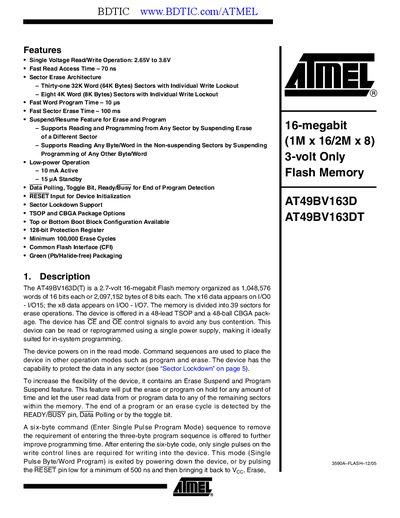
The AT49BV163D(T) is a 16‑megabit flash memory offered in 48‑lead TSOP and 48‑ball CBGA packages. It operates from 2.65 V to 3.6 V and provides fast read (70 ns), program (10 µs) and sector erase (100 ms) times, with low‑power active (10 mA) and standby (15 pA) currents.
The device supports sector‑lockdown, erase/program suspend‑resume, a 128‑bit protection register, and a Common Flash Interface (CFI) for software discovery. Detailed pin configurations, command sequences, and timing diagrams are provided for system designers.
| Memory capacity | 16 megabit (2,097,152 bytes) |
|---|---|
| Operating voltage | 2.65 V to 3.6 V |
| Fast read access time | 70 ns |
| Fast word program time | 10 µs |
| Fast sector erase time | 100 ms |
| Active current | 10 mA |
| Number of sectors | 39 sectors |
| Package options | 48‑lead TSOP and 48‑ball CBGA |
| Minimum erase cycles | 100,000 cycles |
| Protection register size | 128 bits (two 64‑bit blocks) |
The device operates from 2.65 V up to 3.6 V.
The memory is divided into 39 individually erasable sectors.
Erase suspend allows an ongoing sector or chip erase to be paused so that other sectors can be read or programmed, then resumed later.