
The document provides an introduction to the working principle of Philips air cleaner filters. It includes 5 filtration stages: adsorption of harmful gases, trapping bacteria and viruses, trapping fine particles, eliminating odors, and cleaning air.
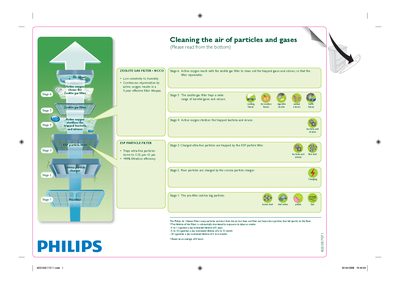
The Philips Air Cleaner uses a multi‑stage filtration system to remove particles, odors, bacteria and viruses from indoor air. The stages include a pre‑filter for large particles, a corona charger that ionises finer particles, an ESP particle filter that captures ultra‑fine particles, and a zeolite gas filter that adsorbs harmful gases.
Active oxygen is periodically generated to sterilise trapped microorganisms and to rejuvenate the zeolite filter, providing a five‑year effective lifespan under normal conditions. Filter life is reduced by exposure to cigarette smoke, with estimated lifetimes ranging from five years down to a few months depending on usage.
| Filtration efficiency | >99% |
|---|---|
| Minimum particle size captured | 0.02 µm |
| Effective filter lifespan (normal use) | 5 years |
| Sensitivity to humidity | Low |
| Filter life with 1 cigarette/day | ≈5 years |
| Filter life with 5‑10 cigarettes/day | 6–12 months |
| Filter life with 20 cigarettes/day | 3–6 months |
The filter provides an effective lifespan of about five years when used under normal indoor conditions.
Exposure to cigarette smoke shortens the filter life: about five years with one cigarette per day, 6‑12 months with 5‑10 cigarettes per day, and 3‑6 months with 20 cigarettes per day.
The ESP particle filter can trap ultra‑fine particles down to 0.02 µm.
The filter has low sensitivity to humidity.