
Kingston 4GB 512M x 64-Bit DDR3-1600 CL9 240-Pin DIMM is a 2Rx8 memory module based on sixteen 256M x 8-bit FBGA components. This module has been tested to run at DDR3-1600 at a low latency timing of 9-9-9-27 at 1.65V. The SPD is programmed to JEDEC standard latency DDR3-1333 timing of 9-9-9. This 240-pin DIMM uses gold contact fingers.
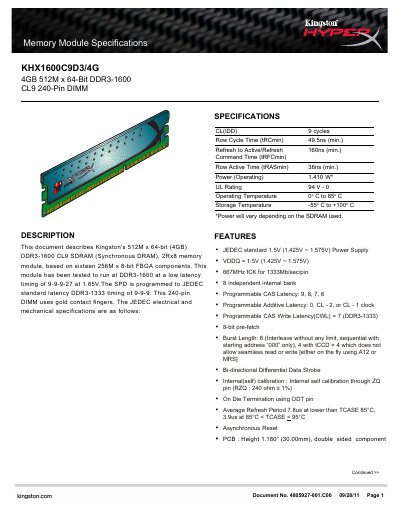
This document details the Kingston KHX1600C9D3/4G 4 GB DDR3‑1600 CL9 240‑pin DIMM memory module. It describes the module’s architecture, JEDEC‑standard voltage, timing options, and key features such as programmable CAS latency and on‑die calibration.
The manual provides full electrical, mechanical, and thermal specifications, as well as module dimensions and recommended operating conditions. It also includes a disclaimer about over‑clocking and a link for further information.
| CAS Latency (CL) | 9 cycles |
|---|---|
| Row Cycle Time (tRCmin) | 49.5 ns (min.) |
| Refresh to Active/Refresh | 160 ns (min.) |
| Row Active Time (tRASmin) | 36 ns (min.) |
| Operating Power | 1.410 W |
| Operating Temperature | 0 °C to 85 °C |
| Storage Temperature | -55 °C to +100 °C |
| Supply Voltage | 1.425 V – 1.575 V (JEDEC 1.5 V) |
| Clock Frequency | 667 MHz (1333 Mb/s per pin) |
| Module Height | 1.180 in (30.00 mm) |
The module operates at a JEDEC standard 1.5 V, with a tolerance of 1.425 V to 1.575 V.
The module supports programmable CAS latency values of 9, 8, 7, and 6.
No, Kingston does not recommend running the module faster than the published speed, as over‑clocking may damage components.