
This white paper describes how to use Altera® MAX® IIZ CPLDs to control analog systems, including driving audio speakers, controlling LED brightness, motor speed, and servo motor position.
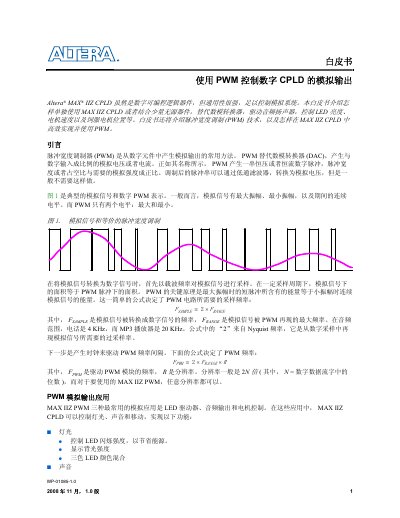
The document introduces PWM as a method for converting digital signals to analog-like outputs using the Altera MAX IIZ CPLD. It describes the theory behind PWM, sampling frequency, and how the CPLD can replace a traditional DAC for driving LEDs, speakers, and motors with minimal external components.
Practical application sections cover LED brightness control, audio playback, and motor speed or position control, including design guidelines such as I/O current limits, the use of MOSFETs for higher‑power motors, and when low‑pass filtering is (or isn’t) required. The white paper also details the internal architecture (LPM_FF, LPM_COUNTER, LPM_ADD_SUB) used to implement PWM in Quartus® II. This manual is written in Chinese.
| I/O current setting | 8 mA |
|---|---|
| Maximum I/O drive capability | 16 mA per pin |
| Logic elements (LE) in smallest device | 240 LE |
Yes, the CPLD can drive LEDs using its 8 mA I/O current setting, and a current‑limiting resistor can be omitted for low‑power LEDs.
A low‑pass filter is not required for LED or motor control, but it is needed when converting PWM to a stable DC voltage for a servo motor.