
Key facts
- Brand
- Analog Devices
- Model
- ADV7172
- Industry
- Industrial
- Documents
- 3
- Languages
- EN
- Last added
- 2012-08-02
Start here
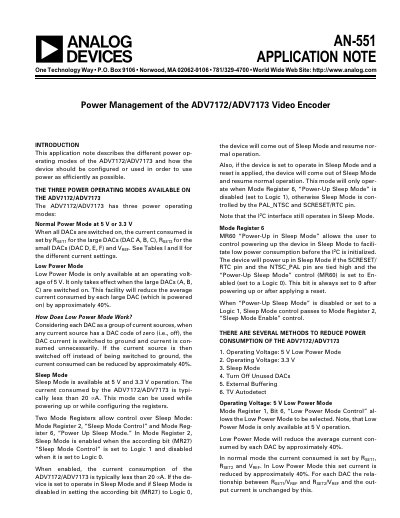
Analog Devices AN-551 Application Note
This document details the three power operating modes available on the ADV7172/ADV7173 video encoder: Normal Power Mode, Low Power Mode, and Sleep Mode. It explains the conditions under which each mode operates and how to configure the device registers to utilize them effectively.
Read onlineAnalog Devices ADV7172 specifications
| Sleep Mode Current Consumption | typically less than 20 pA |
|---|---|
| Maximum Junction Temperature | 110°C |
| Junction-to-Ambient Thermal Resistance | 54.6°C/W |
| Junction-to-Case Thermal Resistance | 16.7°C/W |
All Analog Devices ADV7172 documents by type
Ratings, dimensions and ordering codes, for selection and design work.
How to use the product for one specific task, with worked examples.
Questions answered in these manuals
When is Low Power Mode available?
Low Power Mode is only available at an operating voltage of 5 V.
How does the device exit Sleep Mode?
The device exits Sleep Mode when the Sleep Mode control bit (MR27) is set to Logic 0 or when a reset is applied.
What video standards does the ADV7172/ADV7173 support?
The device supports PAL (B, D, G, H, I, N, M) and NTSC (with and without pedestal) standards.
From: Analog Devices ADV7172/ADV7173 Video Encoder Datasheet
What is the required clock frequency for standard operation?
The encoder requires a single two times pixel rate clock of 27 MHz for standard operation.
From: Analog Devices ADV7172/ADV7173 Video Encoder Datasheet
What is the data rate for the Pixel Port?
The Pixel Port operates at a 27 MHz Data Rate.
From: Analog Devices ADV7172/ADV7173 Video Encoder Datasheet
Which video standards are supported?
The device supports PAL (B, D, G, H, I, N, M) and NTSC (with and without pedestal) standards.
From: Analog Devices ADV7172/ADV7173 Video Encoder Datasheet