
The Sunstar HB100 microwave motion sensor manual explains its principle, features, installation steps and performance specifications.
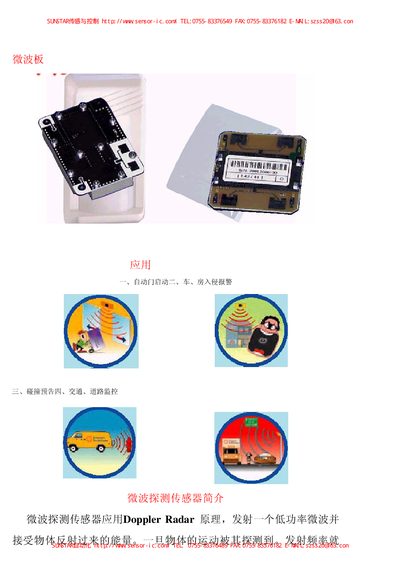
The HB100 is a compact, low‑power microwave Doppler sensor used for applications such as automatic doors, intrusion alarms, traffic monitoring and speed testing. It operates by transmitting a 10.5 GHz signal and detecting frequency‑shifted reflections from moving objects.
The manual provides wiring details (+5 V, GND, IF), recommended mounting orientation, antenna radiation pattern, and key electrical specifications including supply voltage, current consumption, detection range and operating temperature. This manual is written in Chinese.
| Operating frequency | 10.520 – 10.530 GHz |
|---|---|
| Radiated power | 12 – 20 dBm |
| Supply voltage | 4.75 – 5.25 VDC |
| Current consumption | 30 – 40 mA |
| Detection range | 15 – 20 m |
| Operating temperature | -15 °C to 55 °C |
The sensor can detect motion up to 15–20 meters.
It operates from a 4.75 V to 5.25 V DC supply.
Typical current consumption is 30–40 mA.
The IF output includes a DC component around 0.1 V and a Doppler‑shifted signal proportional to target speed.