
A catalog describing GE Sensing & Inspection Technologies' contact and immersion ultrasonic transducers, their selection criteria, specifications, and…
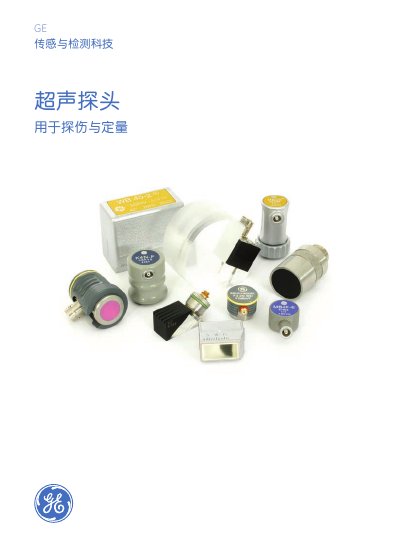
This catalog details ultrasonic transducers from GE Sensing & Inspection Technologies, categorized into contact and immersion types. It provides selection criteria based on application, such as material geometry, flaw orientation, and testing method. Transducers are described by type (e.g., straight beam, angle beam, focused) and use case (manual or automated testing). The document also covers coupling requirements and performance advantages.
The catalog includes technical specifications for probe types, including dual-element (TR) and delay-line configurations, and explains how focusing improves sensitivity and resolution. It is intended for users selecting probes for non-destructive testing applications.
The transducers are divided into two general categories: Contact and Immersion.
These transducers require a couplant layer, which is typically a paste, oil, or gel.
They are suitable for parts with irregular geometries and are the best method for reproducible results and consistent coupling.