
Technical overview of ABB's ultra‑low harmonic (ULH) drives, their active‑front‑end technology and energy‑feedback benefits.
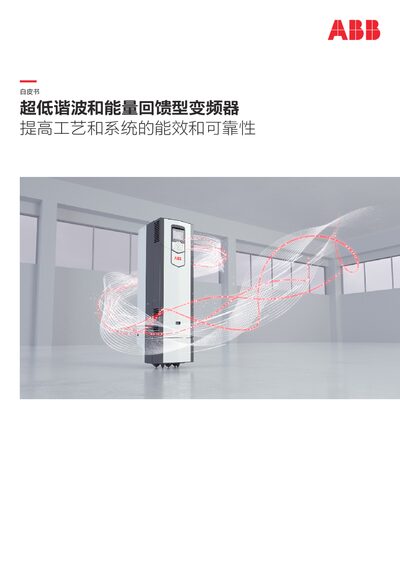
This document explains the importance of harmonic distortion in power grids and how ABB's ULH drives (ACS880, ACH580, ACQ580) mitigate those effects. It covers the impact of inverter‑generated harmonics on system efficiency, component sizing, and reliability in critical facilities such as data centers, hospitals, and water‑treatment plants.
The paper details active‑front‑end (AFE) drive technology, including DC‑bus capacitors and LCL filters, which can lower THDi to around 3 % and enable energy‑feedback operation. It also compares AFE drives with traditional six‑pulse drives and passive filters, providing efficiency data and recommendations for system design. This manual is written in Chinese.
| THDi (harmonic distortion) with ULH drive | ≈ 3 % |
|---|---|
| System efficiency with ULH drive (typical load) | ≈ 87.9 % |
| Harmonic content under rated load | 3 % |
| Power factor improvement | approaches 1.0 |
ABB’s ULH drives achieve a total harmonic distortion (THDi) of about 3 % under typical operating conditions.
An AFE drive uses a DC‑bus capacitor and an LCL filter, eliminating the harmonic‑generating rectifier stage and thus keeping the grid current waveform close to a pure sine wave.
By lowering harmonic distortion, ULH drives avoid the need for oversized cables, transformers, and generators, reducing material costs and improving overall system efficiency.