
The present invention provides a method for constructing a conditional mTERT overexpression mouse model and its application. The construction method comprises the following steps: constructing a targeting vector by seamless cloning technology, wherein the targeting vector comprises a 3.3 kb 5 'homologous arm, a CAG promoter, loxp-stop-loxp, TERT-3XFlag-IRES-EGFP-WPRE-polyA and a 3.3 kb 3' homologous arm; microinjecting Cas9 mRNA, gRNA and the targeting vector into fertilized eggs of wild-type mice to obtain F0 generation mice, and identifying homologous recombination positive F0 generation mice, backcrossing and breeding to obtain F1 generation mice, which are conditional mTERT overexpression mouse models. The mice constructed by the construction method provided by the present invention can be mated with different Cre tool mice to achieve specific overexpression in various tissue organs and cell types throughout the body. The mouse can be used to study the modeling of multiple transgenic models for embryonic and neural development, aging, trauma repair, tumorigenesis and development and treatment, and mating with CreERT tool mice can control the time of TERT overexpression by tamoxifen.
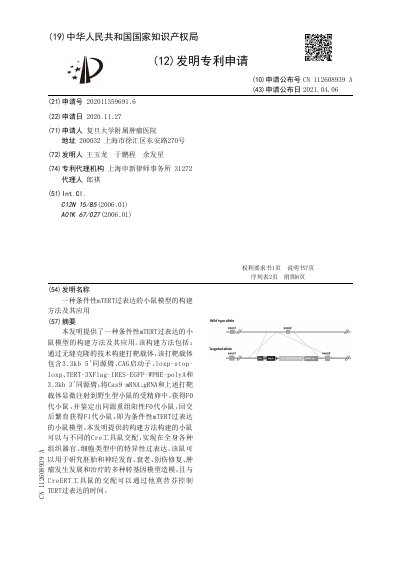
This document describes a method to construct a conditional mTERT overexpression mouse model using CRISPR/Cas9 technology. The model allows tissue-specific expression of mTERT by crossing with Cre tools. It can be used to study tumor development, aging, and neural development in vivo. The method involves constructing a targeting vector with loxp-stop-loxp and TERT-3XFlag-IRES-EGFP-WPRE-polyA, microinjecting it into fertilized eggs, and identifying homologous recombination-positive F0 mice. This manual is written in Chinese.
It describes constructing a conditional mTERT overexpression mouse model, designated R26-e(CAG-LSL-Tert-3XFlag-IRES-EGFP)1, using CRISPR/Cas9 to insert the expression cassette at the Rosa26 locus.
A targeting vector containing 3.3kb 5' and 3' homology arms is microinjected with Cas9 mRNA and gRNA into fertilized eggs from wild-type mice. Homologous recombination-positive F0 mice are identified and backcrossed to obtain F1 mice.
The conditional mouse model is crossed with corresponding Cre mice. In double-positive offspring, Cre removes the loxp-stop-loxp cassette in the tissues and cell types where Cre is expressed, allowing TERT to be highly expressed under the CAG promoter.
The model can be used to study embryonic and neural development, aging, wound repair, and tumor development and treatment. When crossed with CreERT tool mice, tamoxifen can control the timing of TERT overexpression.