
This paper addresses the requirements for the semiconductor sensing circuitry and SCR crowbar devices used in DC power supply over/under voltage protection schemes
This document addresses the requirements for semiconductor sensing circuitry and SCR crowbar devices used in DC power supply over/under voltage protection schemes. It discusses why and where Over Voltage Protection (OVP) is necessary to save money and increase system reliability, particularly for microprocessors and memory chips. The text classifies sense circuits into three types: Zener, Discrete, and MC1723 configurations, analyzing their pros and cons regarding threshold adjustment, noise immunity, and component count.
| Output currents | up to 300 mA |
|---|---|
| Rise time | 400 mA/ µs |
| Supply voltage range | 4.5 V to 36 V |
| Minimum overvoltage duration | 0.5 µs to 1.0 ms |
| Reference voltage | 2.6 V |
To save money and increase the reliability of the system by preventing component failure due to overvoltage or accidental voltage drops.
They are classified into three types: Zener, Discrete, and MC1723 (voltage regulator in OVP configuration).
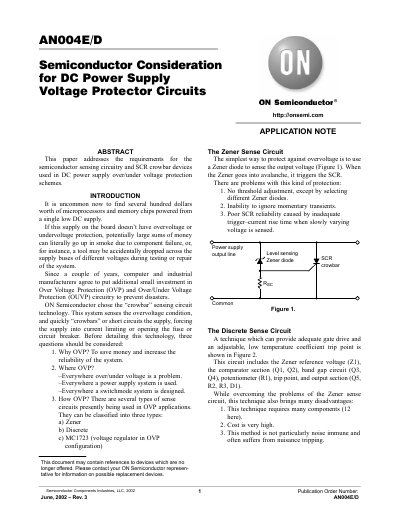
It has no threshold adjustment except by selecting different Zener diodes and cannot ignore momentary transients.
The minimum input voltage range is 9.5 V, restricting its use to higher voltages or requiring an auxiliary supply.