
This document introduces a logic-level transient-voltage protected AC switch, which can be directly driven by a microcontroller unit (MCU) and has robustness against AC line transients to comply with electromagnetic compatibility (EMC) standards.
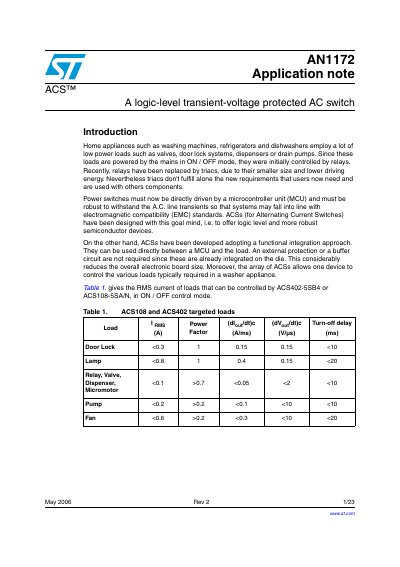
The document introduces ACS (Alternating Current Switches) as a robust semiconductor alternative to relays and triacs for controlling low-power loads like valves, door locks, dispensers, and pumps in home appliances. These devices are designed to be directly driven by microcontroller units while withstanding AC line transients to meet EMC standards.
The note covers the specific triggering mode of ACS devices, which utilizes negative gate current and integrates protection circuits on the die. It provides detailed analysis for controlling inductive loads such as valves, relays, pumps, and fans, explaining how the device handles turn-off overvoltages and thermal stress without requiring external varistors or buffer circuits.
| Targeted Load RMS Current (Valve) | <0.3 A |
|---|---|
| Targeted Load RMS Current (Lamp) | <0.8 A |
| Max supplementary temperature rise (TO92) | < 4°C |
| Max (dV/dt)c rate without snubber | < 10 V/us |
No, ACSs have been developed adopting a functional integration approach where an external protection or buffer circuit is not required since these are already integrated on the die.
No, it can be concluded that no varistor is needed across ACSs to clamp the loads inductive energy at turn-off, even with electromagnets.
The temperature elevation can be neglected as long as the control frequency is less than one Hertz.