
Describes how to measure the holding current of thyristors and triacs.
This document serves as a technical guide for users of TRIACs and thyristors, focusing specifically on the hypostatic or holding current parameter. It illustrates the importance of this parameter through three application examples involving light dimmers and motor control circuits, highlighting issues like flicker effects and torque loss due to incorrect component selection or environmental changes.
The note details how to measure the holding current, noting that values vary based on device sensitivity, junction temperature, and external gate cathode resistors. It provides specific data for sensitive versus standard TRIACs and explains how to combine devices in a Darlington configuration if high sensitivity with a higher holding current is required.
| Holding Current Example (Standard TRIAC) | 8 mA to 40 mA |
|---|
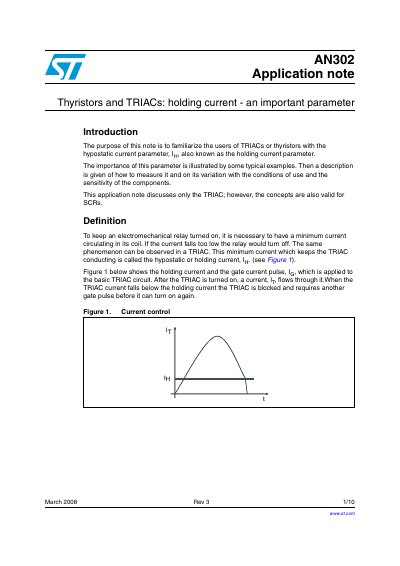
The holding current is the minimum current required to keep the TRIAC conducting; if the current falls below this value, the device blocks.
The holding current varies inversely with temperature; as the temperature decreases, the holding current increases.
It is measured by increasing resistance until the TRIAC blocks, ensuring the initial current was more than five times the latching current.