
This document explains the functionality of the Mode D pin on the ADSP-218x Family of processors, and how to use it.
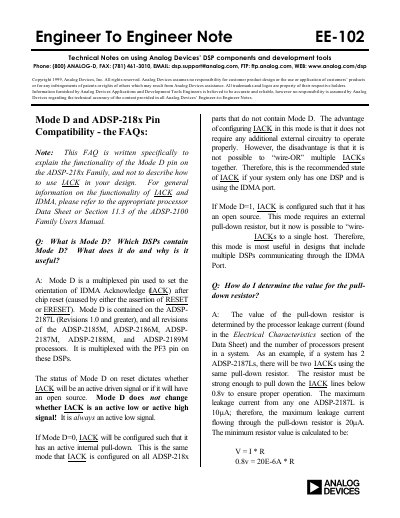
This document is an Engineer-to-Engineer Note (EE-102) from Analog Devices that addresses technical questions regarding the Mode D pin found in the ADSP-218x family of DSPs. It details how the Mode D pin configuration affects the orientation of the IDMA Acknowledge (IACK) signal after a chip reset, specifically distinguishing between active driven and open source configurations.
| Processor Leakage Current (Max) | 10µA |
|---|---|
| Recommended Pull-down Resistor (2 processors) | 40000Ω |
Mode D is a multiplexed pin used to set the orientation of IDMA Acknowledge (IACK) after chip reset. It is contained on the ADSP-2187L (Revisions 1.0 and greater), and all revisions of the ADSP-2185M, ADSP-2186M, ADSP-2187M, ADSP-2188M, and ADSP-2189M processors.
Drive PF3 to logic '0' on reset if using IACK as an actively driven signal, or drive PF3 to logic high if configuring IACK as an open sourced pin.