
This application note describes how to boot an Analog Device's ADSP-2191/95/96 DSP processors.
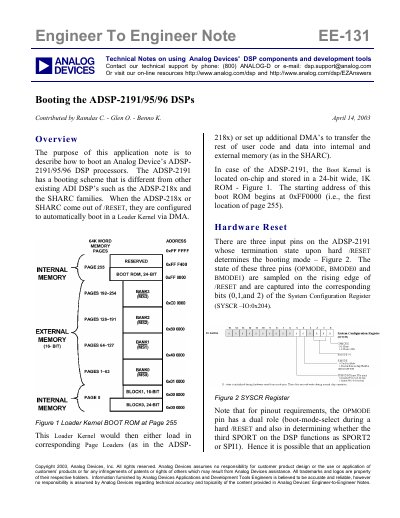
The document details the unique booting scheme for the ADSP-2191/95/96 family of DSPs, which differs from other ADI DSPs like the SHARC series. It explains that upon a hardware reset, the processor is configured to automatically boot via a Loader Kernel located in internal ROM or external memory based on specific pin states.
The guide covers three primary boot modes: executing directly from external memory without a loader kernel, and booting from external sources such as EPROM, Host (UART), SPI, or UART. It provides technical details on the System Configuration Register settings required to select these modes.
The Boot Kernel expects the character 0xAA to be transmitted by an external device.
The Boot Kernel replies with bytes Ox4F and 0x4B, which correspond to 'OK' in ASCII.
Bit rates above 9600bps are not recommended if the signal passes standard EIA-232 cables.