
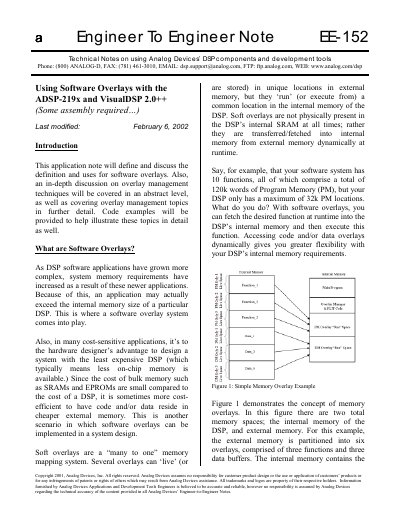
As DSP applications grow in complexity, system memory requirements often exceed the internal memory of a specific DSP chip. Software overlays address this by allowing code and data to reside in cheaper external memory (SRAMs/EPROMs) and be dynamically fetched into the DSP's internal memory at runtime. This technique is particularly useful for cost-sensitive designs where minimizing on-chip memory is advantageous.
| Program Memory (PM) | 32k words for ADSP-2191M; 16k for ADSP-2195; 8k for ADSP-2196 |
|---|---|
| Data Memory (DM) | 32k words for ADSP-2191M; 16k for ADSP-2195; 8k for ADSP-2196 |
| Maximum Overlay Size | 64k words |
It allows an application to exceed internal memory limits by fetching code or data from external memory into the DSP's internal memory at runtime.
Multiple overlays can share the same internal memory segment; for example, three program memory overlays can map to one run space.