
This document discusses the power consumption of ADSP-21371 SHARC® processors based on characterization data measured over power supply voltage, core frequency (CCLK), and junction temperature (TJ).
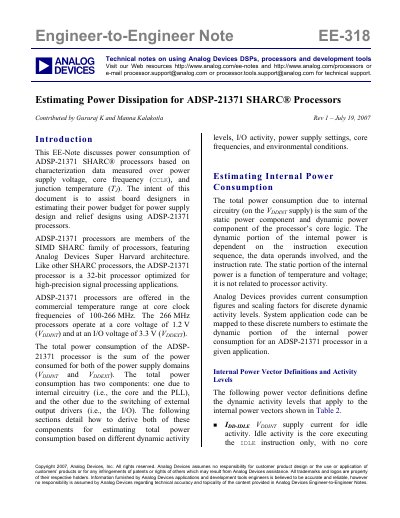
This document, titled "Estimating Power Dissipation for ADSP-21371 SHARC Processors" (EE-318), is a technical note contributed by Analog Devices engineers. It assists board designers in estimating power budgets and supply designs for the ADSP-21371 processor, which operates at core frequencies of 100-266 MHz.
The guide details how to calculate total power consumption by separating it into internal circuitry components (core and PLL) and external output drivers. It defines specific dynamic activity levels—Idle, Low, High, Peak, and Typical Peak—and provides scaling factors and formulas to estimate dynamic current based on application profiling.
| Core Frequency Range | 100-266MHz |
|---|---|
| Operating Voltage (Vopr) | 1.2 V |
| I/O Voltage (Vopexr) | 3.3 V |
The document defines five levels: Idle, Low, High, Peak, and Typical Peak.
No, the test code used to measure Ipp-INPEAK represents worst-case processor operation which is not sustainable under normal application conditions.