
This document describes the external port DMA modes of operation supported on SHARC® processors, including DMA mode, trigger mode and read/write mode. All described modes are supported on ADSP-2106x and ADSP-2116x processors. The ADSP-21367, ADSP-21368, ADSP-21369 (hereafter referred to as ADSP-21368 processors), and ADSP-2137x processors external port supports master mode DMA operation only. These processors do not have the extra logic to support slave mode and read/write mode.
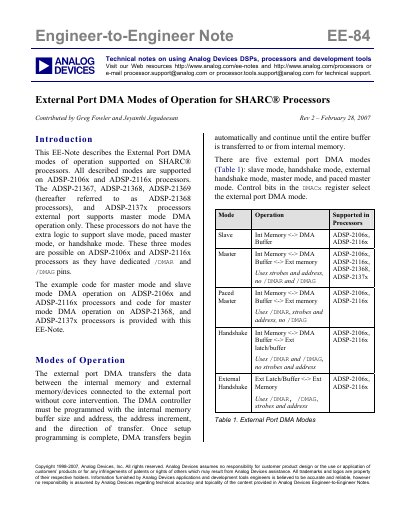
This document details the External Port DMA modes available for ADSP-2106x, ADSP-2116x, ADSP-21368, and ADSP-2137x SHARC processors. It explains that while all listed processors support master mode, only the 2106x and 2116x families support slave, paced master, and handshake modes due to dedicated hardware pins.
The guide covers five specific DMA modes: Slave Mode, Handshake Mode, External Handshake Mode, Master Mode, and Paced Master Mode. It provides details on configuring the DMA controller via control registers (MASTER, HSHAKE, EXTERN bits), utilizing External Port FIFO Buffers (EPBx) for data transfer, and managing data packing logic between internal and external bus widths.
| Supported Processors for Slave/Paced/Handshake Modes | ADSP-2106x and ADSP-2116x processors |
|---|---|
| FIFO Depth for ADSP-2106x | six-deep FIFO |
| FIFO Depth for ADSP-2116x | eight-deep FIFO |
Only the ADSP-2106x and ADSP-2116x processors support slave mode, as they have dedicated /pMaR and /DMAG pins.
There are five external port DMA modes: slave mode, handshake mode, external handshake mode, master mode, and paced master mode.