
This application note describes how to build variable output voltage Boost PFC converters using the FAN9612 Interleaved BCM PFC controller. By adjusting the output voltage, flexible control can be achieved based on the input AC rms voltage level or the output power of the converter. The document also explains different levels of circuit design and implementation.
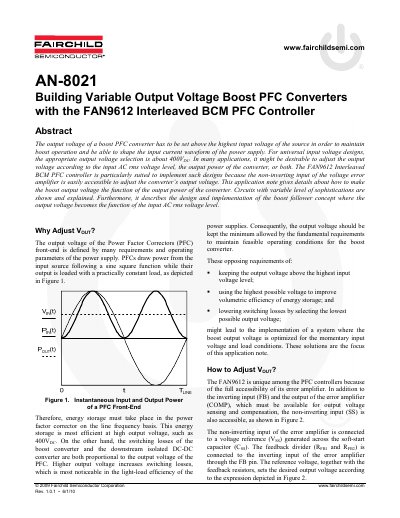
The document explains that while a fixed 400Vpc output is standard for universal input designs, it can be beneficial to lower the output voltage according to the converter's output power or input AC rms voltage. This approach reduces switching losses and improves efficiency under light-load conditions.
The FAN9612 Interleaved BCM PFC controller is highlighted as particularly suited for these designs because its error amplifier inputs are easily accessible. The note provides details on two main strategies: making the output voltage a function of the output power (load-dependent) or implementing a 'boost follower' concept where the output voltage tracks the input AC rms level.
The appropriate output voltage selection is about 400Vpc.
Changing the reference has no effect on loop gain and does not affect over-voltage protection levels, unlike modifying the feedback network.
It is an implementation where the PFC output voltage is proportional to the rms value of the AC input voltage.