
This document describes the features and characteristics of the PUMT1 PNP general purpose double transistor, including low current, low voltage, and reduced number of components and boardspace.
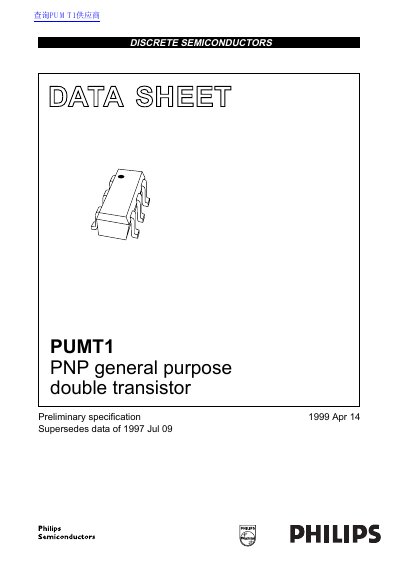
The Philips PUMT1 is a PNP general purpose double transistor designed for low current (max. 100 mA) and low voltage (max. 40 V) applications. It features two independently operating transistors housed in a single SC-88; SOT363 plastic package, which helps reduce the number of components and board space required. The NPN complement of this device is the PUMX1.
| Collector-base voltage (open emitter) | -50 V |
|---|---|
| Collector-emitter voltage (open base) | -40 V |
| Emitter-base voltage (open collector) | -5 V |
| Collector current (DC) | -100 mA |
| Peak collector current | -200 mA |
| Peak base current | -200 mA |
| Total power dissipation (Tamb < 25 °C) | 200 mW |
| Storage temperature | -65 to +150 °C |
| Junction temperature | 150 °C |
| Thermal resistance (junction to ambient) | 416 K/W |
| Collector cut-off current (Veg = -30 V) | -100 nA |
| DC current gain | 120 |
| Collector-emitter saturation voltage | -200 mV |
| Collector capacitance | 2.2 pF |
| Transition frequency | 100 MHz |
The NPN complement of the PUMT1 is the PUMX1.
The PUMT1 uses an SC-88; SOT363 plastic package.
It is intended for general purpose switching and amplification.