
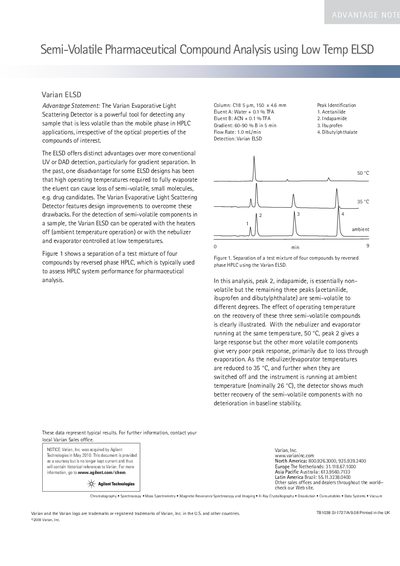
The Varian Evaporative Light Scattering Detector is a powerful tool for detecting any sample that is less volatile than the mobile phase in HPLC applications, irrespective of the optical properties of the compounds of interest. The ELSD offers distinct advantages over more conventional UV or DAD detection, particularly for gradient separation. In the past, one disadvantage for some ELSD designs has been that high operating temperatures required to fully evaporate the eluent can cause loss of semi-volatile, small molecules, e.g. drug candidates. The Varian Evaporative Light Scattering Detector features design improvements to overcome these drawbacks. For the detection of semi-volatile components in a sample, the Varian ELSD can be operated with the heaters off (ambient temperature operation) or with the nebulizer and evaporator controlled at low temperatures. Figure 1 shows a separation of a test mixture of four compounds by reversed phase HPLC, which is typically used to assess HPLC system performance for pharmaceutical analysis.
The Varian Evaporative Light Scattering (ELSD) Detector is designed to detect samples less volatile than the mobile phase, offering distinct advantages over conventional UV or DAD detection, especially during gradient separations. It addresses historical limitations where high operating temperatures caused the loss of semi-volatile, small molecules such as drug candidates.
The document illustrates these capabilities with a test mixture containing acetanilide, indapamide, ibuprofen, and dibutylphthalate. Results show that reducing nebulizer and evaporator temperatures to 35°C or operating at ambient temperature significantly improves the recovery of semi-volatile components compared to standard 50°C operation, without deteriorating baseline stability.
The stated flow rate for the analysis is 1.0 mL/min.