
Varian 380-LC series is a range of advanced evaporative light scattering detectors from Polymer Laboratories, now a part of Varian, Inc. The Varian 385-LC delivers sub-ambient evaporation down to 10 °C, providing maximum sensitivity for compounds with significant volatility below ambient temperature. The Varian 380-LC is the instrument of choice for non-volatile compounds, where temperatures of 100 °C or above are required. Both instruments benefit from fast data output rates and extremely low dispersion for fast LC, and deliver a universal response down to the low nanogram range for truly representative analysis. Repeatability is less than 2% for improved consistency of results. Real-time gas control eliminates solvent effects to provide a constant response across a gradient. Control and digital data collection come as standard for multi-vendor platforms and so there is no need for an analog to digital converter. On-the-fly adjustment of light source intensity also saves time during a run, too - all in the smallest footprint around. Being complementary to LC/MS, and offering unrivalled flexibility and sensitivity, the Varian 380-LC series are the ELSDs of choice for the most demanding applications.
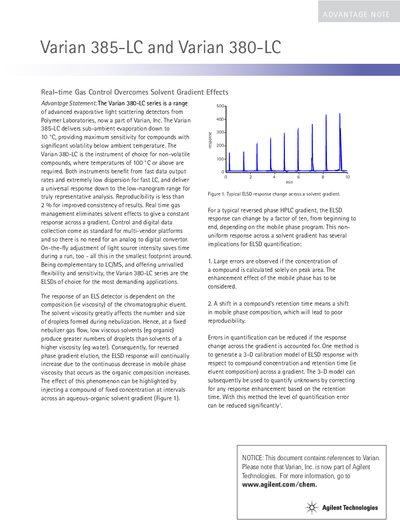
The Varian 380-LC series of evaporative light scattering detectors (ELSD) addresses the issue of non-uniform response caused by changing solvent viscosity during gradient elution. Standard fixed gas flow leads to significant signal enhancement as organic composition increases. This document details the technology used to maintain a constant response.
| Minimum Evaporation Temperature | 10 °C |
|---|---|
| Reproducibility | less than 2 % |
| Detection Range | low-nanogram range |
It uses real-time control of the evaporator gas flow to keep the number of particles reaching the optics constant throughout the gradient.
It eliminates solvent effects to give a constant response across a gradient, whereas fixed flow causes the response to increase significantly.
Yes, control and digital data collection come as standard for multi-vendor platforms.