
The Varian Evaporative Light Scattering Detector provides highly consistent results in peak area response, regardless of the molecular weight of the sample. Accurate and reproducible peak areas are essential when quantifying a sample using a calibration of response versus concentration.
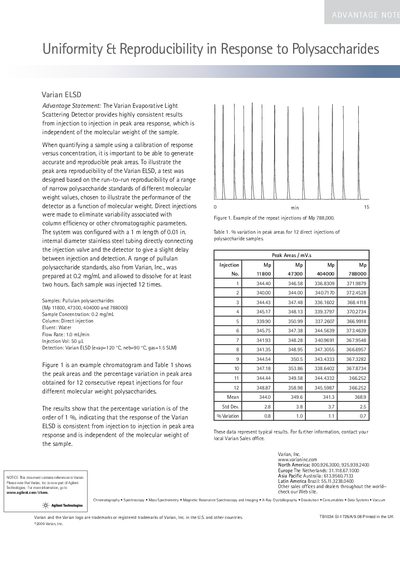
The document describes a test designed to evaluate the run-to-run reproducibility of the Varian Evaporative Light Scattering Detector (ELSD). The test utilized direct injections of a range of narrow polysaccharide standards with different molecular weight values to illustrate performance independent of molecular weight.
The results, based on 12 consecutive repeat injections of four different polysaccharide samples, show that the percentage variation in peak area response is of the order of 1%. This indicates that the detector provides highly consistent results from injection to injection.
| Sample Concentration | 0.2 mg/mL |
|---|---|
| Injection Volume | 50 lL |
| Detection Temperature (Evap) | 120 °C |
| Nebulizer Temperature | 90 °C |
| Gas Flow Rate | 1.5 SLM |
No, the response is independent of the molecular weight of the sample.
The samples were prepared at a concentration of 0.2 mg/mL.
Each sample was injected 12 times to measure reproducibility.
The detection settings included an evaporation temperature of 120 °C and a nebulizer temperature of 90 °C.