
TurboDDS is an advanced scanning form of the 500 Ion Trap LC / MS. TurboDDS can be used to automatically gain qualitative information based on simple operator-specified criteria. The system performs MS/MS and MSn experiments in a single analytical run. The results assist analysts in structural elucidation and unknown identification.
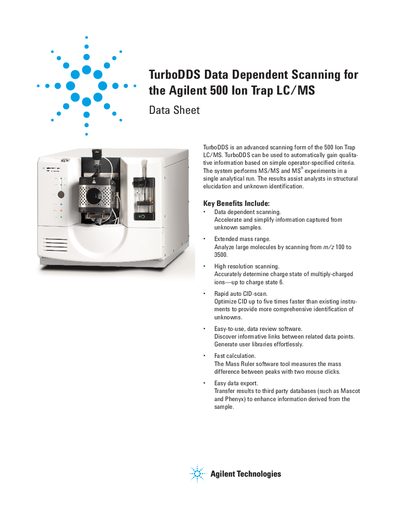
The document introduces TurboDDS, an advanced scanning form of the Agilent 500 Ion Trap LC/MS. It allows the system to automatically gain qualitative information based on operator-specified criteria, performing MS/MS and MSn experiments in a single analytical run to assist in structural elucidation and unknown identification. Key benefits include extended mass range up to m/z 3500 and high-resolution scanning for multiply-charged ions.
| Mass Range | m/z 100 to 3500 |
|---|---|
| Charge State Resolution | up to charge state 6 |
| Maximum MSn Depth | 5 |
| Maximum Breadth | 10 |
TurboDDS is an advanced scanning form that automatically gains qualitative information based on simple operator-specified criteria.
The system can analyze large molecules by scanning from m/z 100 to 3500.
The system can accurately determine the charge state of multiply-charged ions up to charge state 6.
The rapid auto CID-scan optimizes CID up to five times faster than existing instruments.