
bq2058t lithium ion pack supervisor is a device to control charge and discharge cell voltage limits for two lithium ion (li-ion) series cells, accommodating battery packs containing series/parallel configurations. the low operating current does not overdischarge the cells during periods of storage and does not significantly increase the system discharge load. bq2058t can be part of a low-cost li-ion charge control system within the battery pack. bq2058t controls two external fets to limit the charge and discharge potentials. bq2058t allows charging when each individual cell voltage is below vov (overvoltage limit). if the voltage on any cell exceeds vov for a user-configurable delay period (tOVD), the open-drain chg pin goes to the high-impedance state, shutting off charge to the battery pack. this safety feature prevents overcharge of any cell within the battery pack. after an over-voltage condition occurs, each cell must fall below vce (charge enable voltage) for the bq2058t to re-enable charging. bq2058t is a low-cost, low-power, high-performance lithium ion battery pack supervisor suitable for a variety of lithium ion battery pack applications.
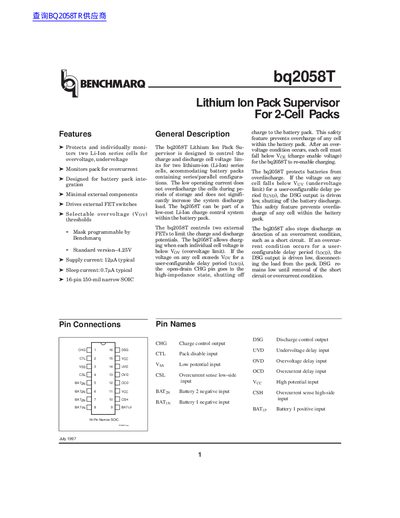
The bq2058T is a Lithium Ion Pack Supervisor designed to protect and monitor two Li-Ion series cells. It controls external FET switches to limit charge and discharge potentials based on overvoltage, undervoltage, and overcurrent conditions.
The device features selectable overvoltage thresholds (standard 4.25V), low supply current of 12uA typical, and sleep current of 0.7uA typical. It is available in a 16-pin 150-mil narrow SOIC package.
| Supply current | 12uA typical |
|---|---|
| Sleep current | 0.7uA typical |
| Package type | 16-pin 150-mil narrow SOIC |
| Overvoltage threshold (standard) | 4.25V |
| Sample rate | 60ms typical |
The standard version has an overvoltage limit of 4.25V.
The standard version of the bq2058T has an overvoltage limit of 4.25V.
The device consumes a typical sleep current of 0.7uA.
Undervoltage protection is asserted when a cell voltage drops below 2.25V.