
Differential proteome analysis: Two-dimensional nano LC/MS of E. coli proteome grown on different carbon sources
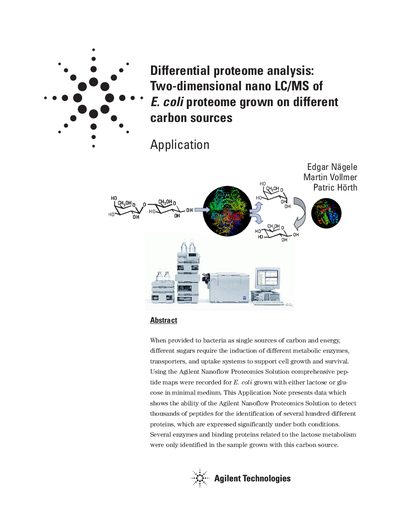
This document presents an application note detailing the use of the Agilent Nanoflow Proteomics Solution for differential proteome analysis. The study analyzes E. coli proteomes grown on glucose versus lactose to demonstrate the system's ability to identify thousands of peptides and hundreds of proteins under different metabolic conditions. The note highlights the advantages of 2D nano LC/MS over traditional 2D gel electrophoresis for proteomics research.
| Flow rate of nanoflow pump | 450 nL/min |
|---|---|
| Column 1 (Reversed phase) | ZORBAX 300 SB C18, 75 pm x 50 mm, 3.5 pam particles |
| Column 2 (Enrichment) | ZORBAX 300SB C18, 0.8mm x 5mm, 5pm particles |
| Column 3 (Strong cation exchange) | PolyLC Inc., Polysulfoethyl A, 0.82 mm x 50 mm, 5 pm particles |
| Software used | Agilent ChemStation A09.03 and Ion Trap software 4.1 |
The Agilent Nanoflow Proteomics Solution was used for the analysis of the complete E. coli proteomes.
The analysis identified 305 proteins from the lactose culture and 450 proteins from the glucose culture.