
The document introduces the use of Gel-Filtration standards and the performance testing of ZORBAX GF-250 columns. The ZORBAX GF-250 column can effectively separate the components of the Bio-Rad® gel-filtration standard between thyroglobulin (670 KDa) and Vitamin B12 (1.35 KDa). The document also discusses the application and results of using gel-filtration test mixtures to test ZORBAX GF-250 columns.
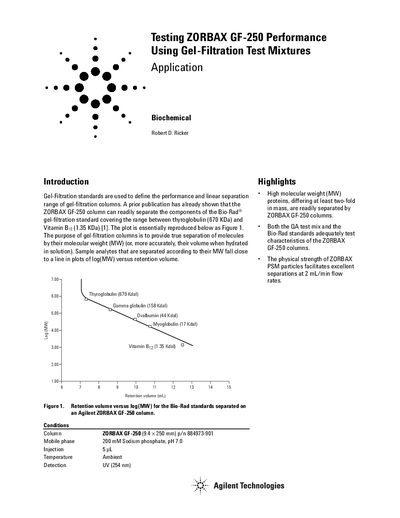
This document describes an application for testing the performance of Agilent ZORBAX GF-250 gel-filtration columns. It utilizes standard Bio-Rad gel-filtration mixtures and a specific QA test mix to define the column's linear separation range and verify its ability to separate molecules by molecular weight.
The text details chromatographic results obtained under specific conditions, including a 200 mM Sodium phosphate mobile phase at pH 7.0. It compares the separation of proteins like Thyroglobulin, Gamma globulin, and BSA against small molecules like Vitamin B12 and sodium azide. The document also investigates the effect of flow rates (1 mL/min and 2 mL/min) on theoretical plate numbers and separation efficiency.
| Column dimensions | 9.4 x 250 mm |
|---|---|
| Part number | 884973-901 |
| Mobile phase | 200 mM Sodium phosphate, pH 7.0 |
| Detection wavelength | 254 nm |
The document recommends using both the Bio-Rad gel-filtration standard and the QA test mix to test column performance.
Increasing the flow rate from 1 mL/min to 2 mL/min significantly improves the theoretical plate number for sodium azide.
The elution time and separation between sample components within the test mix should be used to test the column for chemical integrity.