
A variety of heat-shock proteins (HSPs) were identified in E. coli grown under heat-shock conditions using Agilent Nanoflow Proteomics Solution.
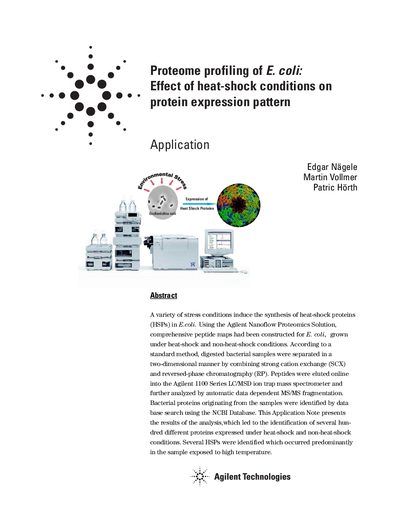
This document describes an experiment utilizing the Agilent Nanoflow Proteomics Solution to analyze protein expression patterns in Escherichia coli (E. coli) subjected to heat-shock conditions versus non-heat-shock controls. The study aimed to identify specific Heat Shock Proteins (HSPs) induced by temperature stress.
The analysis employed a fully automated two-dimensional nano LC/MS/MS method combining Strong Cation Exchange (SCX) and Reversed-Phase chromatography coupled with an Agilent 1100 Series LC/MSD Trap SL mass spectrometer. Results identified several hundred proteins, including specific HSPs like GroEL, GroES, and Dnak that were predominantly expressed under high-temperature conditions.
| Temperature increase for heat-shock induction | 30 °C to 42 °C |
|---|---|
| Heat-shock incubation duration | 30 minutes |
| SCX elution salt concentration range | 20 to 1000 mM |
| Flow rate for nanoflow pump | 450 nL/min |
The identified heat shock proteins GroEL, GroES and Dnak play an important role in regulation of the heat-shock response.
Up to 500 proteins were identified in a single 2D LC experiment.