
This Application Note describes the optimization of the Agilent 1100 Series high throughput LC/MS system for different analytical tasks. It provides detailed instructions on how to optimize chromatography, diode-array and MSD detection to achieve highest sample throughput in combination with substance identification, how to acquire quantitative information while maintaining very high sample throughput, and how to achieve fast analysis of very low sample amounts.
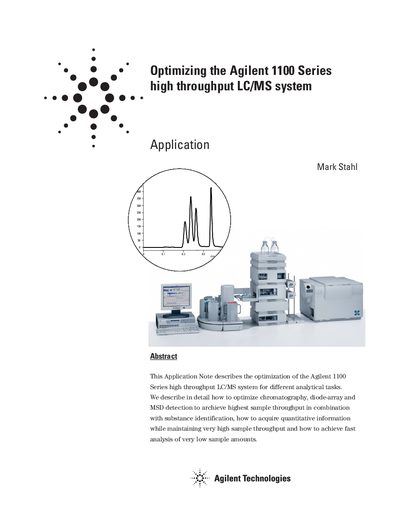
The document addresses the growing need in analytical labs to process thousands of samples daily. It categorizes analyses into three groups: highest sample throughput with substance identification, best quantification while maintaining high throughput, and highest sensitivity with fast analysis.
To achieve these goals, the note details theoretical backgrounds regarding chromatography parameters such as particle size, flow rates, and gradient volumes. It specifically recommends using small particle diameters below 2 µm to minimize dead volume and increase efficiency.
Columns below the length of 30 mm are recommended.
The internal diameter should be greater than 3.9 mm to avoid excessive backpressure.
A 0.5 or a 1-minute gradient can be regarded as standard gradients.