
This Application Note describes different flow splitter designs and configurations used in high-purity separations.
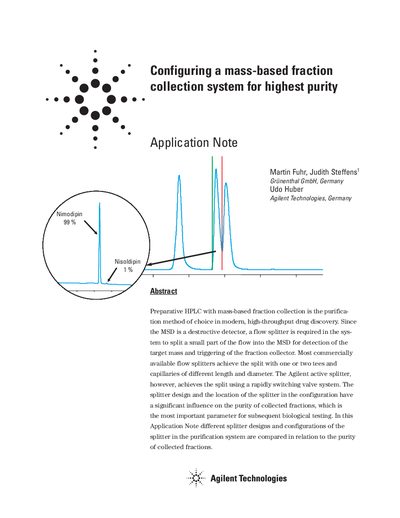
This document discusses the importance of flow splitter design and configuration in mass-based fraction collection systems for preparative HPLC. It compares passive splitters, which use tubing of varying lengths, against the Agilent active splitter, which uses a rapidly switching valve system. The text highlights that the active splitter offers adjustable split ratios and minimal peak dispersion compared to passive designs.
| Column | ZORBAX SB-C18, 21.2 x 50 mm, 5 µm |
|---|---|
| Flow rate | 25 mL/min |
| Injection volume | 500 µL |
| Split ratio (active) | 1:9500 |
| Split ratio (passive) | 1:1000 |
The configuration that places the splitter directly after the UV detector provides the best purity results.
No, this configuration is only possible with the active splitter because the passive splitter creates too high a back-pressure.
The active splitter has almost no back-pressure and no delay volume, preventing peak dispersion.