
This Application Note describes the development of conventional HPLC and Rapid Resolution LC (RRLC) methods for the analysis of Buplerui (Chaihu). A comparison of fingerprint chromatograms of different Buplerui samples showed different peak profiles of different TCMs collected from different places. The method for the Agilent 1200 Series Evaporative Light Scattering Detector (ELSD) was optimized to achieve maximum response. A quantitative method was developed to determine the six types of saikosaponins in different TCMs and their preparations.
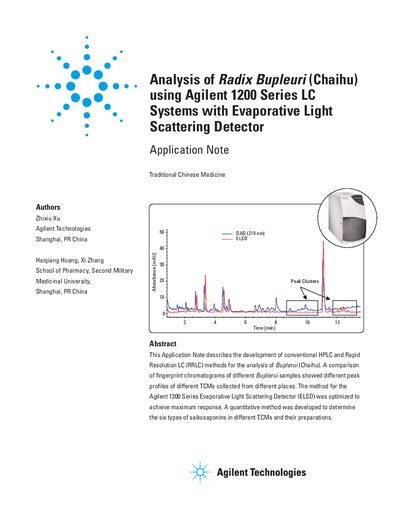
This document details the development of conventional High-Performance Liquid Chromatography (HPLC) and Rapid Resolution LC (RRLC) methods for analyzing Radix Bupleuri (Chaihu), a popular Traditional Chinese Medicine. The study focuses on determining six types of saikosaponins, which are believed to be the most important therapeutic components.
The application note compares fingerprint chromatograms from different Chaihu samples collected from various locations and discusses the optimization of the Evaporative Light Scattering Detector (ELSD). It demonstrates that ELSD provides a stable baseline compared to UV detection at low wavelengths, allowing for better integration of peaks without interference from volatile solvents or impurities. Two specific methods are provided: one conventional HPLC method with a 60-minute run time and an optimized RRLC method reducing the analysis time to 6 minutes.
The study determined that a temperature of 40 °C and a pressure of 55 psi provided the best results for analyzing saikosaponins.
The procedure requires treating finely powdered dried plant materials in 8 mL of methanol containing 2 % pyridine.
The RRLC analysis reduced the run time from 60 minutes down to 6 minutes while maintaining similar efficiency.