
Explains how the Agilent 7020 ZetaProbe can be used to control the stability of a colloid
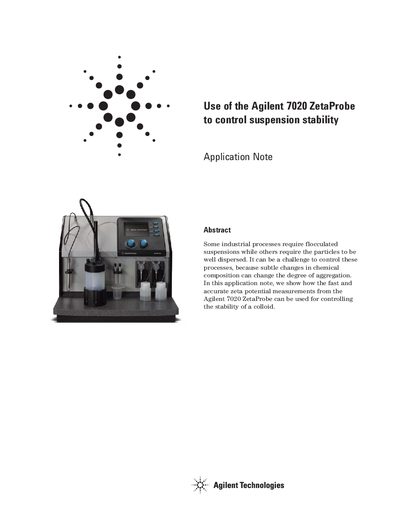
The document discusses the importance of controlling aggregation or dispersion in colloidal suspensions, noting that subtle changes in chemical composition can alter these states. It highlights that zeta potential is a critical parameter for determining repulsive forces between particles and maintaining stability.
The Agilent 7020 ZetaProbe is presented as an ideal tool for this purpose because it measures zeta potential directly without requiring sample dilution, which traditional optical methods often necessitate. The note provides examples of using the device to determine optimal pH ranges for stability and to monitor the dosage of dispersants.
| Minimum solids concentration for measurement | about 0.5% solids |
|---|---|
| Maximum volume percentage for emulsions | 60% |
| Required zeta potential for stable dispersion | at least 25 mV |
Dilution takes time and often changes the zeta potential, whereas the ZetaProbe can measure it directly in concentrated suspensions.
It uses a patented multifrequency electroacoustic technique to make an adequate estimate of the effective size.