
Agilent 7020 ZetaProbe Titania Coating QC Application Note

Definitive Quality Control of Titania Coatings with the Agilent 7020 ZetaProbe
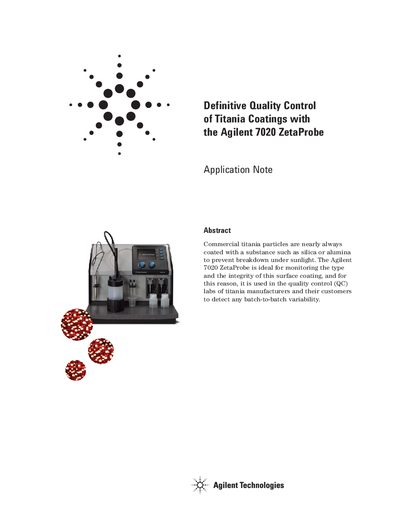

Agilent 7020 ZetaProbe Titania Coating QC Application Note - cover page
Brand
Agilent
Category
Other Electronics
Document type
Application Note
Language
English
Pages
4
File format
PDF
File size
189 KB
Published
02 July, 2012
Updated
01 October, 2023
MD5 checksum
B3BE11AF9EABB110A446C531564FB3ED

About this manual

Commercial titania particles are often coated with substances like silica or alumina to prevent photoactive breakdown. The Agilent 7020 ZetaProbe is an ideal tool for quality control labs to detect batch-to-batch variability in these surface coatings. The instrument determines the isoelectric point (IEP) by plotting zeta potential against pH, which clearly indicates the type and integrity of the coating.

What's inside

  • Definitive Quality Control
  • The importance of coatings for titania
  • Titration using the ZetaProbe
  • Electroacoustic measurement provides insight into the coating process
  • Conclusion

Frequently asked questions

What is the Agilent 7020 ZetaProbe used for in titania manufacturing?

It is used to monitor the type and integrity of surface coatings on titania particles to detect batch-to-batch variability.

How quickly can the ZetaProbe determine the isoelectric point?

The instrument can determine the isoelectric point to better than 0.1 pH units in under half an hour.

Does the ZetaProbe require sample dilution for measurements?

No, it does not require sample dilution because it uses a patented electroacoustic technique for concentrated suspensions.

Download PDF (189 KB)

More Agilent Manuals


View all Agilent manuals →