
This Application Brief describes a method for sampling formaldehyde and acetaldehyde in air using a DNPH-impregnated silica gel cartridge and analyzing them by HPLC. The method has a limit of detection of 0.25 μg/m3 and 0.35 μg/m3.
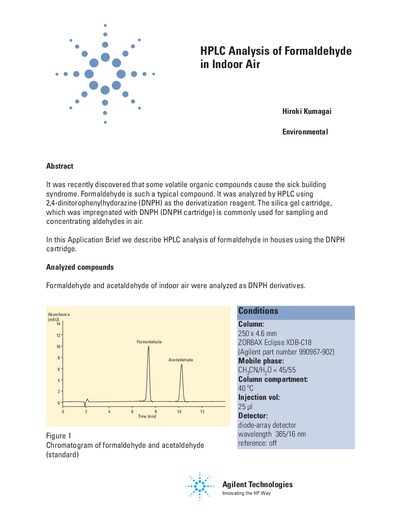
The document details an HPLC method for analyzing volatile organic compounds, specifically formaldehyde and acetaldehyde, found in indoor air. The analysis utilizes a silica gel cartridge impregnated with 2,4-dinitrophenylhydrazine (DNPH) as the derivatization reagent to concentrate aldehydes from air samples.
The method employs an Agilent 1100 Series HPLC system equipped with a vacuum degasser, quaternary pump, autosampler, thermostatted column compartment, and diode-array detector. The analysis uses a ZORBAX Eclipse XDB-C18 column (250 x 4.6 mm) with a mobile phase of acetonitrile/water at a ratio of 45/55.
It describes how to analyze formaldehyde in indoor air using HPLC with a DNPH cartridge.
The limit of detection for formaldehyde is 0.25 g/m3.