
This article presents a novel method for the indirect determination of fluoride traces in natural waters using ion chromatography and ICP-MS detection. The method offers significant advantages in terms of speed, high sensitivity, and simultaneous measurement of multiple elements.
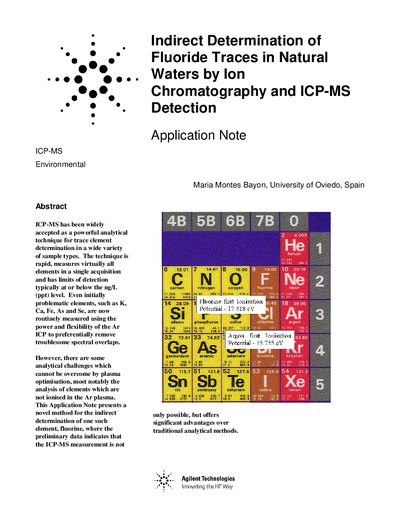
This document presents a novel analytical method for the indirect determination of fluorine, an element that is not ionized in argon plasma, using Inductively Coupled Plasma Mass Spectrometry (ICP-MS). The method involves the formation of an AlF2+ complex in acid aqueous solution, which is then separated using a Dionex Ion Pac Column HPIC-CG2 and detected by measuring aluminum at mass 27 via ICP-MS.
The note details the experimental setup, including instrument operating conditions for an HP 4500 ICP-MS and specific chromatographic parameters using 0.45 M nitric acid as an eluent. It reports analytical characteristics such as a detection limit of 0.1 ng/g, a precision of 4%, and a linear range up to 100 ng/g. The method was validated against Fluoride Ion Selective Electrodes (FISE) in fresh and sea water samples, demonstrating good agreement and recovery rates.
| Detection Limit | 0.1 ng.g |
|---|---|
| Precision | 4% |
| Linear Range | up to 100 ng.g |
| Sampling rate | 6-7 samples per hour |
The detection limit obtained by the IC-ICP-MS method was 0.1 ng/g.
The optimum pH for the complex formation is between 2-4, with pH 2.6-3 selected in this work.
HNO3 (nitric acid) was found to be an effective eluent for the separation of AlF2+ from the excess of Al3+.