
The document is an application introduction, mainly describing the features and characteristics of the product.
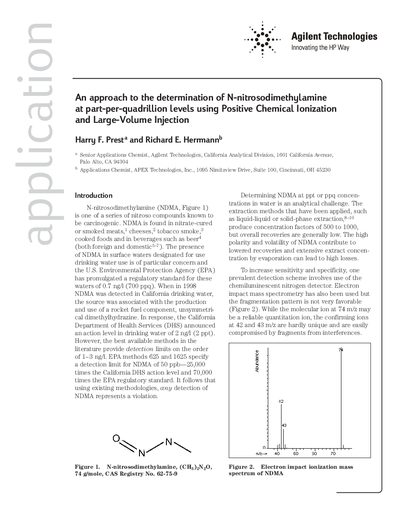
The document presents a method to determine the carcinogenic compound N-nitrosodimethylamine (NDMA) in water samples at extremely low concentrations, addressing regulatory standards set by the EPA and California DHS. It highlights the limitations of existing methods, such as Electron Impact mass spectrometry, which suffer from poor selectivity due to non-unique fragmentation patterns.
To overcome these challenges, the authors propose a combined technique utilizing Positive Chemical Ionization (PCI) with ammonia reagent gas and Large-Volume Injection (LVI). This approach simplifies the mass spectrum by generating specific protonated and ammonium adduct ions, significantly enhancing sensitivity and signal-to-noise ratios compared to traditional Electron Impact ionization.
The U.S. Environmental Protection Agency (EPA) has promulgated a regulatory standard of 0.7 ng/l (700 ppq).
At a concentration of 20 fg/µL, the precision (RSD) of the response was less than 3%.