
This document describes a method for the analysis of seven triazine herbicides using GC/MS/MS and multiple reaction monitoring (MRM). The method can be used to detect triazine herbicide residues in corn, apple, grape, wheat, and other crops.
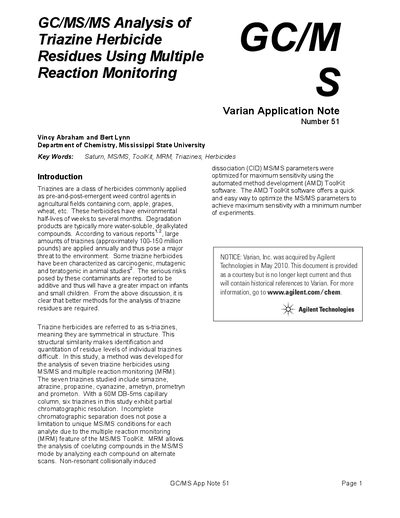
This document details a method developed to analyze seven triazine herbicides (simazine, atrazine, propazine, cyanazine, ametryn, prometryn, and prometon) using Gas Chromatography/Mass Spectrometry/Mass Spectrometry (GC/MS/MS). The method utilizes Multiple Reaction Monitoring (MRM) via the MS/MS Toolkit software to achieve unique analysis conditions for each analyte, allowing for the detection of coeluting compounds in a single chromatographic run. The study highlights the utility of this approach for identifying and quantitating residues of environmentally significant triazines that are difficult to separate chromatographically due to their structural similarity.
| Column | DB-5ms, 60M X 0.25mm X 0.25um |
|---|---|
| Oven Program | 50°C for 1 min., then 20°C/min. to 170°C with no hold time, 3°C/min. to 240°C and hold for 3 minutes. |
| Injector | 270°C Splitless |
| Transfer Line | 300°C |
| Flow Rate | 1.5 ml/min. |
| Mass Range | 50-250 u |
| Filament | 20 wamps |
The method analyzes seven triazines: simazine, atrazine, propazine, cyanazine, ametryn, prometryn, and prometon.
The method uses Multiple Reaction Monitoring (MRM) to analyze each compound on alternate scans, allowing for the analysis of coeluting compounds.
The automated method development (AMD) Toolkit software is used to optimize MS/MS parameters for maximum sensitivity.