
This applications note illustrates the selectivity and sensitivity advantages of an ion trap GC/MS/MS approach to enhance selectivity for the hormone estradiol (estrogen) in blood.
This document illustrates the selectivity and sensitivity advantages of an ion trap GC/MS/MS approach for monitoring the hormone estradiol in medical and pharmaceutical research. It details sample preparation, method development using the Automated Method Development (AMD) feature, and calibration procedures.
The note also describes a novel injection approach using the 1078 injector on the 3400 CX gas chromatograph to perform large volume injections. This technique extends sensitivity without compromising chromatographic separation, allowing for the determination of estradiol at concentrations below 1 pg/L.
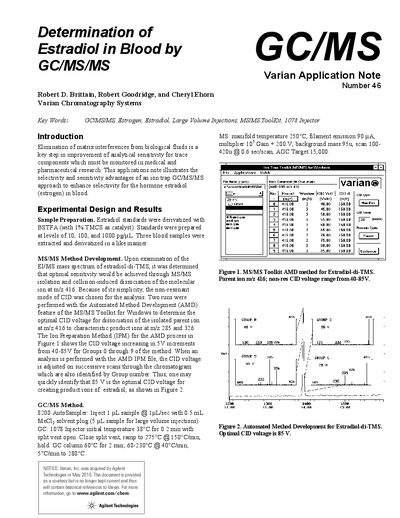
The optimal CID voltage for creating product ions of estradiol is 85 V.
The external standard calibration curve was prepared at levels of 10, 100, and 1000 pg/L.
Using this approach, the GC/MS/MS method may be used to determine estradiol at < 1 pg/L concentrations.