
This document introduces the analysis methods of tributyltin and triphenyltin in the environment, including the analysis methods of these compounds in water samples, sediment and liver, muscle tissue.
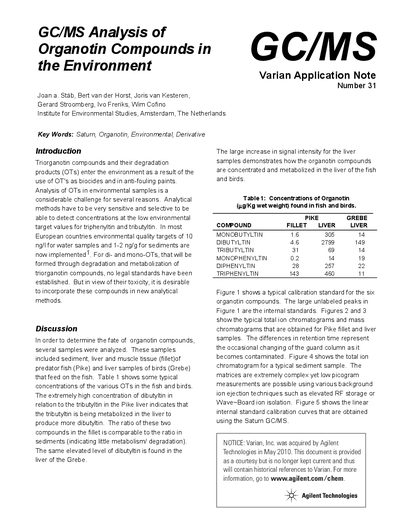
This document presents an analytical procedure for detecting organotin compounds (OTs) in environmental samples such as water, sediments, and biological tissues. It addresses the challenge of detecting low concentrations of these compounds, which are used as biocides and in anti-fouling paints.
The note details a specific method involving the derivatization of standards and samples with Pentyl Magnesium Bromide Grignard reagent. It provides typical chromatographic conditions for the Gas Chromatograph and Mass Spectrometer, including column specifications, oven programs, and mass spectrometer settings. The document includes data on organotin concentrations found in Pike and Grebe samples and displays typical chromatograms and calibration curves obtained using the Saturn GC/MS.
| Column | 0.25 mm x 0.25 um with a 2 meter DB-5 30M x retention gap of deactivated fused silica 0.53 mm |
|---|---|
| Flow rate | 1 mL/min |
| Injection volume | 7.5 pL |
| Mass range segment 1 | 280-325u |
| Mass range segment 2 | 275-355u |
| Mass range segment 3 | 390-462u |
| Scan rate | 100 scans/min |
Organotin standards and samples were derivatized with Pentyl Magnesium Bromide Grignard reagent.
The target value is 10 ng/l for water samples.