
This application note describes a stable isotope dilution mass spectrometry (SIS-MS) method for the quantitation of orotic acid in urine samples for diagnostic and exploration of OCT deficiency.
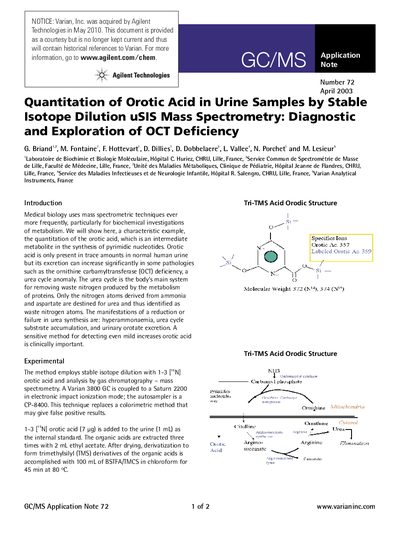
This document details a method for the quantitation of orotic acid in urine samples using stable isotope dilution with 1-3 [15N] orotic acid and analysis by gas chromatography-mass spectrometry (GC/MS). The technique is designed to detect even mild increases in orotic acid, which is clinically important for diagnosing ornithine carbamyltransferase (OCT) deficiency, a urea cycle anomaly. The method replaces colorimetric methods that may yield false positive results.
| Column | Varian CP-SIL8 CB Low Bleed/MS 30m x 0.25 mm x 0.25 um |
|---|---|
| Flow Rate | 1 mL/min |
| Injection Temperature | 250 °C |
| Oven Program | 40 °C no hold, 30 °C/min to 70 °C, hold 6 min, 5 °C/min to 280 °C |
| Injection Mode | Splitless |
| Injection Volume | 0.5 pL |
| Transfer Line | 280 °C |
| Mass Range | 350-365 m/z |
| Calibration Curve Equation | y = 0.14x + 0.047 |
| Correlation Coefficient | 0.997 |
| Limit of Detection | 0.05 mg/L |
| RSD for duplicate analysis | 4% |
The limit of detection is 0.05 mg/L.
The correlation coefficient for the response curve is 0.997.