
The THS3201 is a wide-band, high-speed current-feedback amplifier, designed to operate over a wide supply range of ±3.3 V to ±7.5 V for todays high performance applications. It features a unity gain bandwidth of 1.8 GHz, a high slew rate of 10500 V/µs, and low distortion performance, making it ideal for arbitrary waveform driver applications and driving high-resolution, high-sampling rate ADCs. Additionally, the THS3201 is well-suited for broadcast video and HDTV applications.
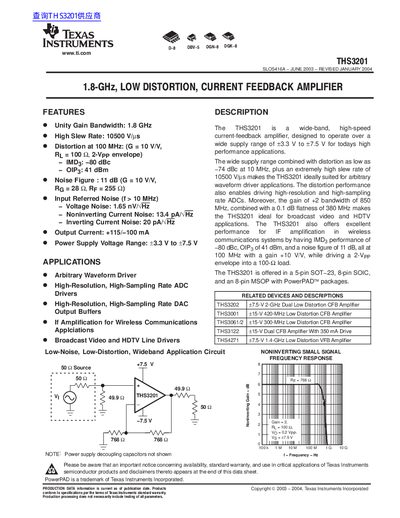
The THS3201 is a wide-band, high-speed current-feedback amplifier designed to operate over a supply range of +3.3 V to +7.5 V for high-performance applications. It features a unity gain bandwidth of 1.8 GHz and a slew rate of 10,500 V/µs.
| Unity Gain Bandwidth | 1.8 GHz |
|---|---|
| High Slew Rate | 10500 V/s |
| IMD3 | -80 dBc |
| OIP3 | 41 dBm |
| Noise Figure (G = 10 V/V) | 11 dB |
| Input Referred Voltage Noise | 1.65 nV/√Hz |
| Noninverting Current Noise | 13.4 pA/√Hz |
| Inverting Current Noise | 20 pA/√Hz |
| Output Current (Sourcing) | +115 mA |
The device operates over a wide supply range of +3.3 V to +7.5 V.
The THS3201 is offered in 5-pin SOT-23, 8-pin SOIC, and an 8-pin MSOP with PowerPAD packages.
The typical small-signal bandwidth at a gain of +1 is 1.3 GHz.